
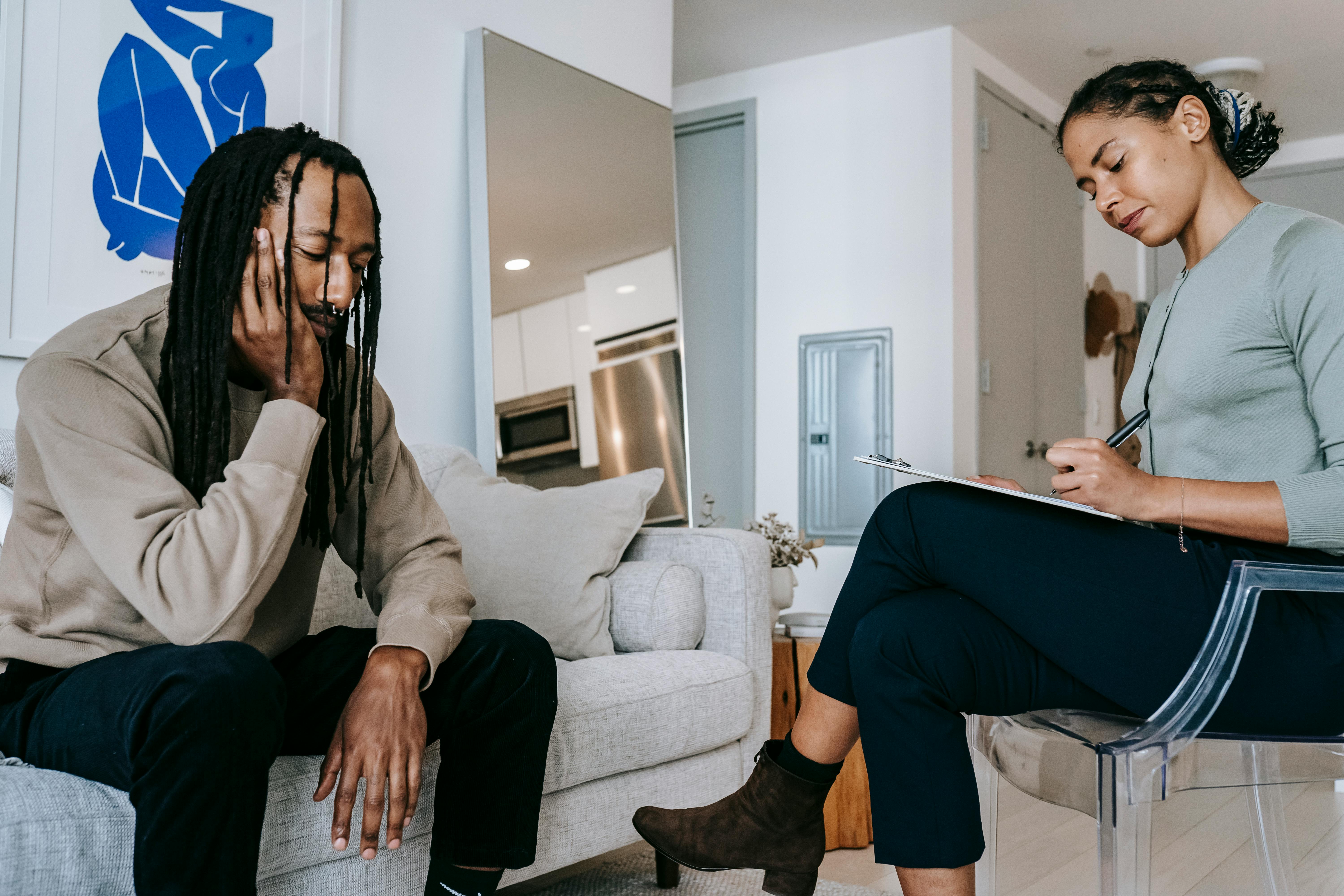
Peer support groups meet in community halls, hospital rooms and video calls, run by people with lived experience rather than clinicians. Their format is more deliberate than it appears, and the structure is what makes an unpaid volunteer able to hold the room.
The tradition comes from mutual aid, not from medicine
Peer groups descend from mutual aid societies rather than clinical services. The organising idea is that people with a shared experience have something to offer each other directly.
That origin explains features that look odd from a clinical standpoint: no assessment, no notes, no treatment plan and no professional in charge.
It also explains the emphasis on equality within the room. The person who has attended for years holds no formal authority over the person attending for the first time.
Where clinical services define a relationship between an expert and a patient, mutual aid defines a relationship between people in comparable positions.
Turn-taking is the core mechanism
Most groups run on sequential speaking. Each person speaks in turn for a bounded period, and nobody interrupts.
The rule does two things at once. It guarantees quieter members airtime, and it prevents the group being dominated by whoever is most fluent or most in crisis.
A bounded turn also lowers the barrier to speaking. Knowing that a contribution ends at a defined point makes starting one less daunting.
Groups that abandon turn-taking usually drift into conversation between the three or four most confident attenders, and attendance among the rest falls away.
No cross-talk is a safety rule, not a politeness rule
Many groups prohibit responding directly to what another person has said, particularly with advice. This is the convention usually described as no cross-talk.
The purpose is to remove the risk of a person disclosing something difficult and immediately receiving judgement, instruction or an unwanted comparison.
It also stops the group becoming an arena where members compete to give the best answer, which changes what people are willing to say.
Members who want to respond do so afterwards, informally and individually. The rule governs the structured portion of the meeting rather than the whole encounter.
Some formats relax this deliberately, allowing shared reflection but not advice, which requires more skilled facilitation to hold.
Facilitation is about the frame, not the content
The facilitator opens the meeting, states the format, watches the clock and closes it. They do not interpret, diagnose or direct.
This narrow role is what makes the position holdable by a volunteer. Managing a frame is a learnable skill; managing clinical content is not.
Facilitators are usually rotated, both to distribute the load and to prevent the role hardening into an informal leadership position.
Training, where it exists, concentrates on opening scripts, handling distress in the room, and knowing when to signpost outside the group.
Anonymity conventions vary by tradition
Some traditions use first names only and treat anonymity as a founding principle. Others are open, and members may be publicly associated with the group.
The strict version protects people whose difficulty carries stigma or legal risk, and it makes the group accessible to those who would not attend otherwise.
Open groups gain something different: visibility, easier recruitment and the ability to advocate publicly on behalf of members.
Whichever convention applies, the confidentiality rule about what is said in the room is nearly universal and is usually restated at every meeting.
The economics keep groups free
Most groups charge nothing or pass a voluntary contribution. Costs are limited to room hire and refreshments, and volunteers absorb the rest.
Staying unpaid keeps a group independent. Accepting funding introduces reporting requirements, and reporting sits awkwardly with confidentiality.
It also keeps the group outside the referral economy. A group with no waiting list and no eligibility criteria can accept whoever arrives.
The trade-off is fragility. A group depends on two or three people continuing to show up, and it can dissolve quickly if they stop.
What keeps a group alive over years
Longevity correlates with boring things: a fixed day, a fixed time, a stable venue and a predictable format.
Predictability matters more here than elsewhere because people arrive in difficult states and rely on knowing exactly what the hour will contain.
Groups that move venue frequently or change format tend to lose attendance and often do not recover it.
Succession is the other determinant. Groups that rotate facilitation early survive the departure of a founder; groups organised around one person usually do not.
How this differs from group therapy
Group therapy is led by a trained clinician who works with the interaction between members as the material of the work.
A therapist may deliberately surface conflict, note patterns in how members relate, and use the group's dynamics as part of the treatment.
Peer groups avoid all of that. They are not attempting to change anyone; they provide a place where an experience can be described among people who recognise it.
The two are frequently used together, and experienced facilitators are explicit that the group is not treatment and does not replace it.