
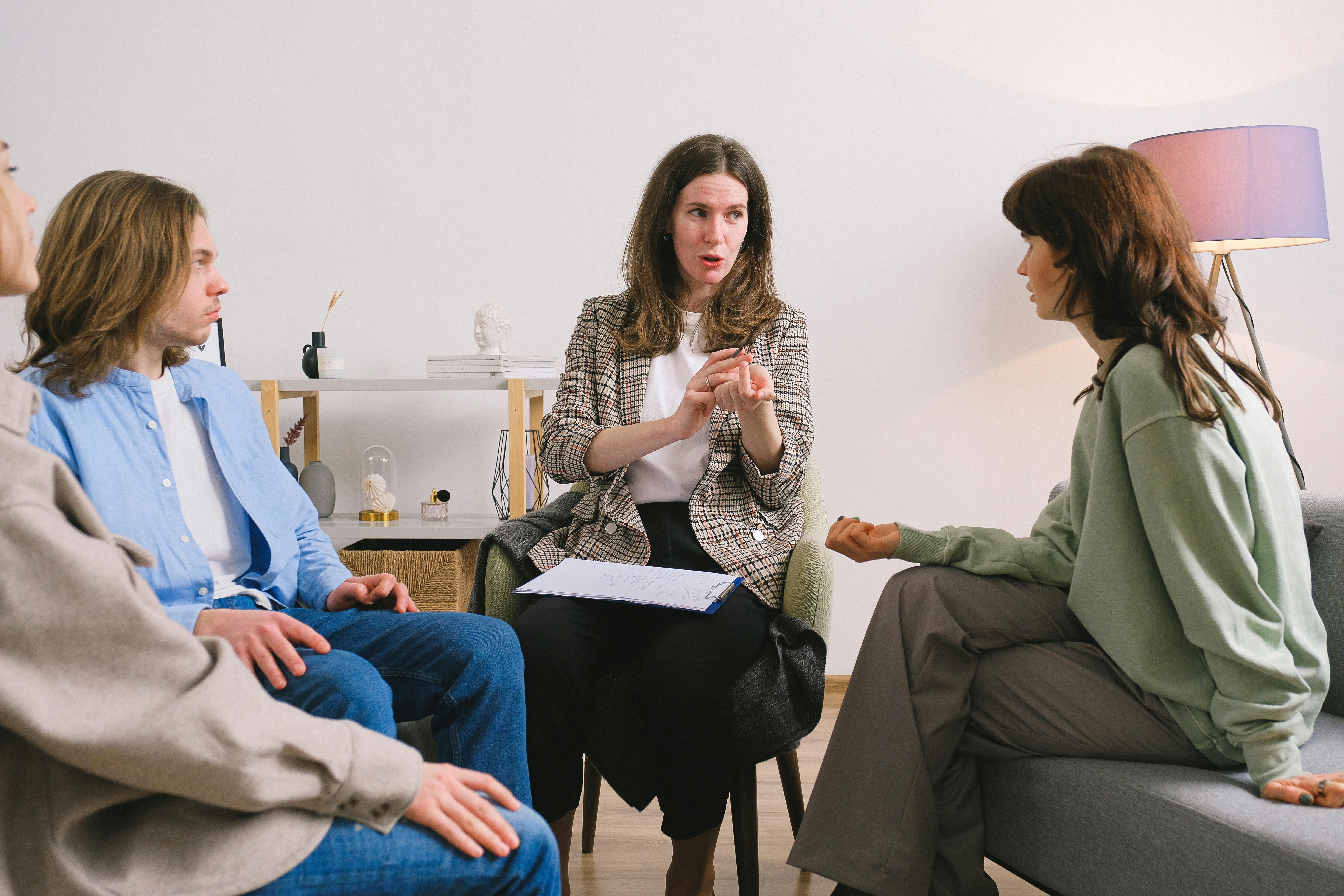
Group therapy rooms in American clinics look similar wherever they are: a closed circle of identical chairs in a plain room. Each element of that arrangement is chosen for a reason.
The circle removes a front of the room
Chairs in rows create a direction of attention and a person at the front. A circle removes both, so no seat is structurally more authoritative than another.
That matters because group therapy relies on members addressing each other rather than routing everything through the clinician. Rows would make the leader the audience for every statement.
Every member is also visible to every other member. Reactions become part of the shared material instead of happening behind someone's back.
Chair count is set before anyone arrives
The number of chairs equals the number of expected members plus the leaders, with no extras left standing around the edges.
An empty chair is visible information. It marks an absence the group can notice and discuss rather than allowing the missing member to disappear quietly.
Identical chairs are used deliberately. A different or better seat would signal status, and status differences are among the things a group is meant to surface rather than build in.
Boundaries are physical as well as verbal
The door is closed and often positioned so late arrival is visible, because entering is an event the group registers rather than something that slips past.
Groups typically start and end at fixed times regardless of who has arrived. The frame is held consistently, and reactions to it become clinical material.
Rooms are chosen for sound isolation, since confidentiality is the precondition for anything difficult being said and a thin wall undermines it entirely.
Composition is decided in advance
Members are screened individually before joining. Clinicians assess whether a person can tolerate the format and whether the mix will function as a working group.
Groups may be homogeneous, gathering people around a shared concern, or deliberately mixed so that differences generate the friction the work depends on.
Open groups admit new members over time and closed groups run with a fixed cohort, and the choice determines how much of each session is spent re-establishing trust.
Two leaders serve different functions
Many groups run with co-leaders. One can attend to the member speaking while the other tracks the rest of the room.
Co-leaders also model disagreement handled directly, which is often the specific interaction members have had little exposure to.
Whether a group is appropriate for a particular person is a clinical decision made during screening, not something to determine from a description of the format.